A country of nearly 223 million inhabitants1, Nigeria remains to this day the main producer of crude oil in sub-Saharan Africa.
With 1.5 million barrels of black gold produced per day2, Nigeria, a member of OPEC3, is a heavyweight in the global oil industry.
Since its rise in power in the 1960s, the oil sector has always had a special place in the Nigerian economy with its own codes.
In fact, it was foreign companies that intervened from the early days of the industry in the prospecting, exploitation and development of the oil industry for export purposes4.
This complex implementation was done within the framework of an agreement with local elites to the detriment of the civilian populations whose role was at best to participate as semi-skilled or skilled labor5.
The original configuration of this sector of the Nigerian economy generated from its beginnings, a deficit in the oil trade balance, at the center of which is the paradox of Nigeria being a major producer, but a “small refiner”.
A cost-benefit approach shows that it is much cheaper to import refined oil from abroad for local consumption, particularly oil from countries with expertise in the exploitation of this raw material.
The sustainability of this mode of operation, which is heavily dependent on foreign players for both the local exploitation of crude oil and the importation of refined petroleum products, therefore raises questions.
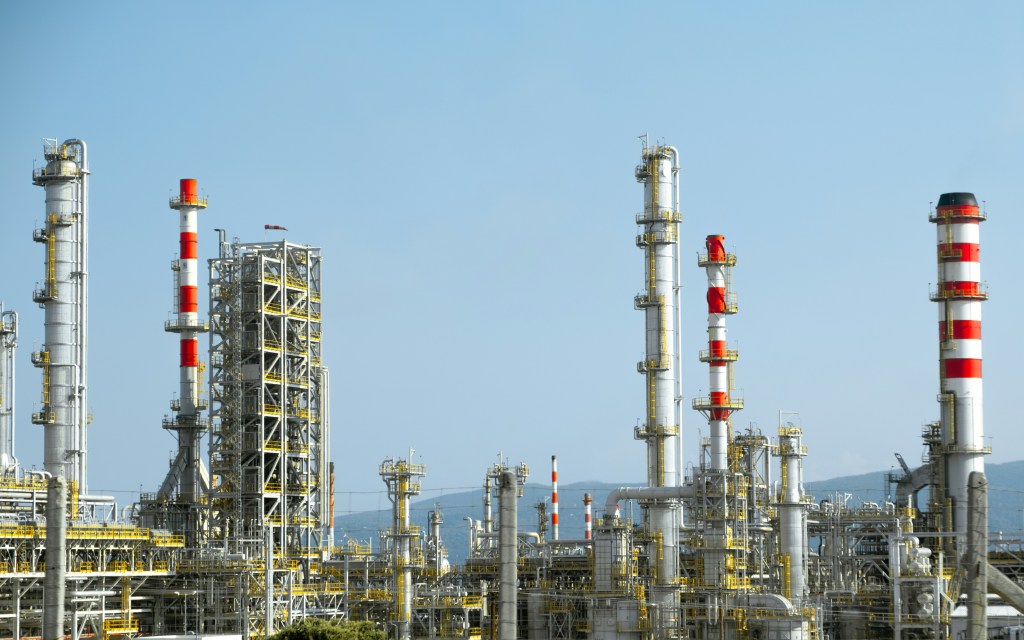
It is in this context that the cement industrialist Aliko Dangote launched the project of a Nigerian refinery that would transform crude oil into refined products in Nigeria6.
This project, initially estimated at $9 billion, was completed in 2024 with a total amount of $19 billion spent7.
The stated objective of this titanic undertaking is therefore to gradually move away from dependence on imports of refined petroleum products.
Initially, the purchase of refined crude oil would be done, in the manner of the country’s public companies, from foreign suppliers.
Then, gradually, the refinery would obtain its supplies directly from local producers.
This project is based on the observation of the recurring gasoline shortages that the Nigerian population suffers on a daily basis.
It aims, in the long term, to alleviate a situation that is weakening the continent’s leading economy8.
Previously in the 1990s, the Nigerian government adopted a strategy for developing the local oil market focusing on diversifying players to allow new Nigerian companies to challenge the market shares of the world’s major oil companies9.
This “local content” policy aimed to facilitate the participation of the local bourgeoisie in one of the country’s most lucrative economic activities.
Between the 1900s and 1950s, during the British colonial occupation and particularly in the years that followed, the major oil companies that had invested considerable sums in oil prospecting in Nigeria entered into agreements with local elites10.
This is why, from its inception, the industry was mainly geared towards foreign interests to the detriment of the majority of Nigerians.
The opening of the market to local players did not fundamentally change the initial structure of this industry, which operated as a separate body within the Nigerian economy.
The diversification of players perpetuating the mechanisms for monopolizing oil revenues has even strengthened a system for which the most vulnerable populations pay the price11.
The refinery project of the Nigerian billionaire Aliko Dangote is therefore part of this context of the need for energy and economic independence for Nigeria.
With its 650,000 barrels per day potentially refined, this project is therefore at the centre of the Nigerian economic and political game and could allow the country to position itself as a major source of supply at regional and international levels.
- ‘World Bank Open Data’, World Bank Open Data, accessed 22 October 2024, https://data.worldbank.org. ↩︎
- http://‘International – U.S. Energy Information Administration (EIA)’, accessed 22 October 2024, https://www.eia.gov/international/data/world/petroleum-and-other-liquids/annual-petroleum-and-other-liquids-production? ↩︎
- Organization of the Petroleum Exporting Countries ↩︎
- Phia Steyn, ‘Oil Exploration in Colonial Nigeria, c. 1903–58’, The Journal of Imperial and Commonwealth History 37, no. 2 (1 June 2009): 249–74, https://doi.org/10.1080/03086530903010376 ↩︎
- Steyn ↩︎
- ‘Raffinerie de Dangote au Nigeria : ce qu’il faut savoir de ce projet hors normes – Jeune Afrique.com’, JeuneAfrique.com, accessed 22 October 2024, https://www.jeuneafrique.com/1527619/economie-entreprises/raffinerie-de-dangote-au-nigeria-ce-quil-faut-savoir-de-ce-projet-hors-normes/. ↩︎
- ‘Au Nigeria, Le Groupe Du Milliardaire Aliko Dangote Inaugure Une Mégaraffinerie’, accessed 22 October 2024, https://www.lemonde.fr/afrique/article/2023/05/23/au-nigeria-le-groupe-du-milliardaire-aliko-dangote-inaugure-une-mega-raffinerie_6174487_3212.html. ↩︎
- ‘Pénurie d’essence au Nigeria, premier producteur de pétrole d’Afrique’, 16 February 2022, https://www.lemonde.fr/afrique/article/2022/02/16/penurie-d-essence-au-nigeria-premier-producteur-de-petrole-d-afrique_6113901_3212.html. ↩︎
- Jesse Salah Ovadia, ‘Local Content and Natural Resource Governance: The Cases of Angola and Nigeria’, The Extractive Industries and Society 1, no. 2 (2014): 137–46. ↩︎
- Steyn ↩︎
- https://www.climatejusticecentral.org/fr/posts/impact-of-oil-gas-production-on-the-niger-delta ↩︎
 L'Économie Internationale pour toustes